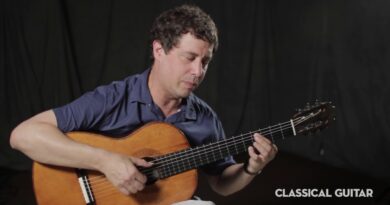
Come On (part 1)????Full Version????Steve Costello????Jimi Hendrix guitar cover ????Electric Ladyland cover
Steve Costello performs Come On (part 1), an SRV and Jimi Hendrix guitar cover from the Jimi Hendrix Experience’s Electric Ladyland album in 1968, and various live concerts. Steve’s guitar playing was inspired by Jimi’s classic version of this blues song along with it’s stops, using the cliche’ Jimi riff – high G and D over low E chord (like in Purple Haze and Voodoo Child) in the chorus, seventh chords, improvised licks over the bass line, and the transitional theme riff: A – B – D — A – B – A — G – E leading into the 4 chord A.
Although this Jimi Hendrix guitar cover of Come On (part 1) is not one of the biggest of the Jimi Hendrix Experience greatest hits, it is one of his most exciting uptempo blues numbers, with a lot of feedback and unique guitar sounds, and was also covered by Stevie Ray Vaughan.
“Come On (part 1)” – Steve Costello – Vocals, Guitar
Background is from unknown source.
The guitar and vocal tracks here have a unique mix of Steve’s style and Jimi’s style, and was performed live with the guitar track over a background track most likely sometime in the late 1990’s or early 2000’s.
This Jimi Hendrix guitar cover was Remastered 2025
Some favorite Jimi Hendrix’s live shows with Come On (part 1):
1-14-1969 Munster
1-22-1969 Vienna Austria
1-23-1969 Sportspalast Berlin
5-17-1969 Providence
8-31-1970 Stockholm
… and many more.
The main influence for this rendition of Come On (part 1) is the studio version, and the many live versions (many audience tapes of Jimi), therefore much of Steve’s influence is coming from many of these audience tapes of Jimi Hendrix’s live shows.
This song is in the Key of E, with the guitar making use of the the open strings, over a variation of a Blues progression, with stops and the typical 5 -4 -1 Blues turnaround.
Feedback sustain with a wawa pedal is tastefully achieved throughout the song with a rich heavy tone.
The guitar riffs have a good mix of repetitive and linear motives with feedback sustain (no whammy bar), combined with solid root resolutions of riffs, making listening to this rendition very enjoyable.
Presented here, as they are re-mastered and uploaded, is one song from the many years of recordings from Cosmo’s and Steve’s analog 4 track recorders. Hence the channel name “Steve Costello – Original Studio Recordings”.
Steve Costello and Cosmo Fasciano recorded various styles of original material from many years of recordings (mid 90’s until about 2010) from analog 4 track recorders, as I had the pleasure of jamming with and recording many songs with the very talented Cosmo Fasciano. I have many of these recordings, along with my own recordings, and these are the recordings which I am now remastering with Audacity, and putting these songs up on this channel. There are many tapes, and some have been re-mastered, but there are still many more to do. The end result is well worth it, but it takes the stress of dealing with analog issues such as matching various tape speeds and pitch, an occasional tape that gets “eaten ” and the hassle of repairing it, and tape deck trim pots oxidizing.
Analyzing songs is very enjoyable. Using the Scientific Deductive Reasoning approach, as with a Jigsaw Puzzle with which one sees the whole completed picture before focusing on where each individual piece goes. Songs are examined from the song key down to actual waveform frequencies. However what is in between these two opposites is extremely interesting, including the song progression, the analysis of melody including it’s motif, contour, rhythm and essential pitches.
Most important is how these musical components work can together to keep the interest level of the listener high, instead of losing interest and becoming board.
The answer is that too much sameness, repetition (as in the same Riff over and over) is boring due to being too predictable, and too much difference, or linear Jazz type phrasing is too unpredictible and hence it as well is boring. So, it is advantageous for the Blues style guitar player who likes to improvises to listen to good Blues players and how they phrase and start a guitar riffs, or motive and vary it, and end it tastefully on the root note. by creating Motives.
Actual waveform frequencies are examined using the tool Audacity for PC. Much thanks to Phil at Wings Of Pegasus for all the in-depth great videos, as he is excellent in song analysis and looking at the actual frequencies. Many thanks to Phil for the idea of using the great App VocalPitchMonitor for analysis. Phil’s work is very valuable, and one can learn much from him, so it is a good idea to check out his channel.
Enjoy!
#JimiHendrixguitarcover #jimihendrixgreatesthits
#part #1Full #VersionSteve #CostelloJimi #Hendrix #guitar #cover #Electric #Ladyland #cover
Originally posted by UCLHFSSeXCPvBraF-iP13E1w at https://www.youtube.com/watch?v=7ztTcTPa-_o